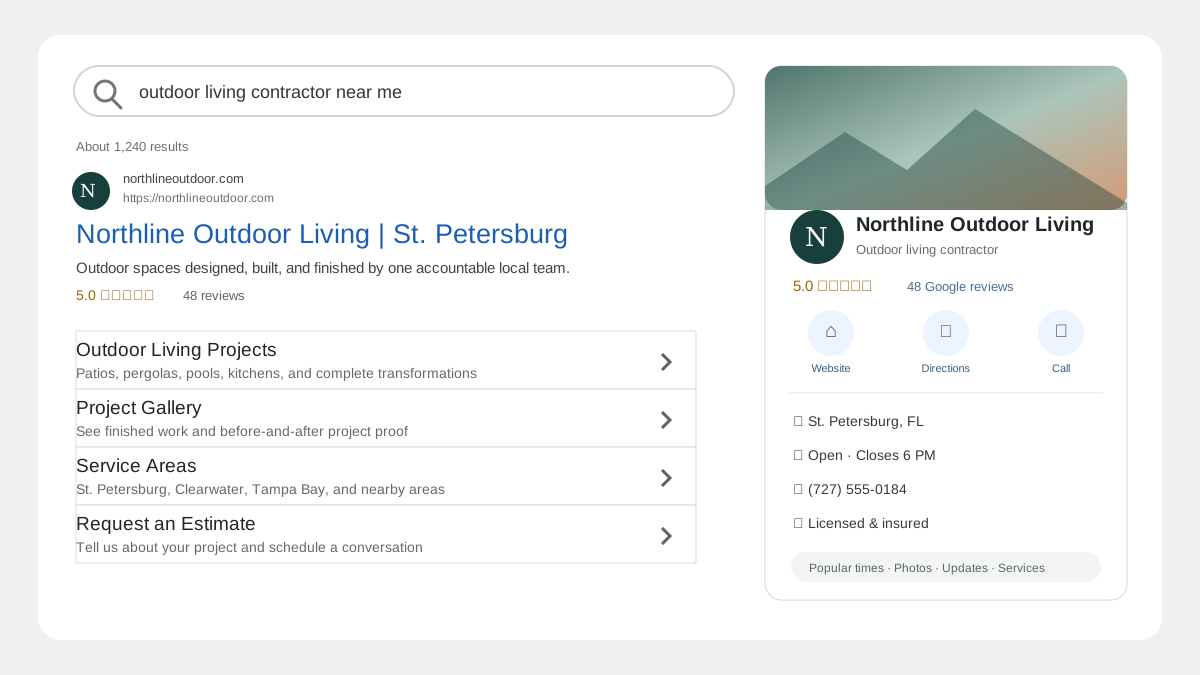
A remodeling contractor can do careful demolition, protect an occupied home, solve a framing surprise, keep selections moving, manage change orders, and finish a room beautifully. None of that guarantees the company will appear when a nearby homeowner searches for the work. Local SEO is how the business makes the right location, services, experience, and proof understandable to both customers and search engines.
The goal is not to repeat “remodeling contractor near me” across every page. It is to build a consistent picture: this is a real company, it performs this work, it serves these places, customers trust it, and there is a clear way to start a conversation. That picture should be visible on the website, the Google Business Profile, project stories, reviews, business listings, and lead-tracking setup.
What local SEO means for a remodeling company
Local SEO is the work of improving how a business appears in location-based search results. For a remodeler, those searches may include “kitchen remodeling contractor,” “bathroom remodeler in St. Petersburg,” or “whole-home renovation company near me.” Google may show a map, a group of local businesses, standard website results, or a mix of them.
The website and Google Business Profile have different jobs, but they should support the same story. The profile helps someone see the company name, category, service area, hours, reviews, photos, and contact options quickly. The website has room to explain the remodeling process, project types, craftsmanship, planning, communication, and what makes the company a good fit.
Understand how Google describes local results
Google says local results are mainly based on relevance, distance, and prominence. Those ideas are useful because they keep the strategy grounded.
Relevance: are you a clear match for the work?
Relevance is about how well the business matches what the person searched for. Choose the most accurate primary Google Business Profile category and only the additional categories that truly describe the company. On the website, give important services enough clear information to stand on their own. A kitchen remodeling page should explain more than the fact that kitchens are available. It can cover planning, cabinet and appliance coordination, lighting, finish selections, jobsite protection, inspections, and how the company manages the sequence of work.
Distance: is the searcher within the area you serve?
Distance depends on where the person is searching and the business or service area location. A company cannot edit its way around geography. The practical job is to represent the real location and service coverage accurately, then create useful evidence of work completed in those communities.
Prominence: is the business established and recognized?
Prominence is influenced by information Google finds about the business across the web, including links, articles, directories, and reviews. For contractors, real project coverage, steady review collection, accurate listings, local relationships, and useful mentions can build a stronger reputation over time. There is no responsible shortcut that replaces doing good work and documenting it well.
Source: Google Business Profile guidance on improving local ranking.
Make the website and Google Business Profile agree
A homeowner should not see one company name on a truck, a different variation on Google, and another on the website. Google’s business representation guidelines emphasize using the name and details the business uses consistently in the real world. Keep the name, phone number, website address, business hours, and location or service-area information current everywhere the company controls.
Consistency is not about forcing every description to use identical wording. It is about avoiding contradictions. If the profile says “remodeler” while the website looks like a general home-services directory, the connection is weak. If the website presents luxury whole-home renovations but the profile is filled with unrelated handyman services, customers and search systems receive a mixed signal.
- Use the real business name without adding cities or services that are not part of it.
- Link the profile to the best website page for the business.
- Keep the primary category focused on the company’s main work.
- Write a plain-language business description that matches the actual service mix.
- Add current hours, contact details, services, and high-quality project photos.
- Review the information after a move, rebrand, phone change, or service-area change.
Source: Google’s guidelines for representing a business.

Set up a service-area business correctly
Many remodelers work from an office or home that customers do not visit. Google distinguishes between a storefront, a service-area business, and a hybrid business. If the company does not receive customers at the address during stated hours, the address should generally be hidden from the public profile and the real service area should be set instead.
Google currently allows up to 20 service areas and asks businesses to define them with cities, postal codes, or other recognized areas rather than an editable radius. Google also advises that the overall area generally should not extend much farther than about two hours of driving time from the business. That does not mean every company should use 20 areas. Use the places the team truly serves and can support consistently.
A clean service-area setup protects trust. A remodeler should not create fake offices, virtual addresses, or duplicate profiles to appear in every nearby town. One eligible profile with accurate coverage, supported by strong website content and real work in the area, is the durable foundation.
Source: Google guidance for service areas.
Build service pages around real remodeling work
A service page should help a homeowner understand whether the company handles the project and whether the working relationship is likely to fit. Thin pages that only swap “kitchen,” “bathroom,” and “home addition” into the same paragraph do not provide that understanding.
Start with the services that materially differ in scope, process, customer questions, or proof. A remodeling website might need distinct pages for kitchens, bathrooms, additions, and whole-home renovations if the company has the experience and information to support them. A page can address:
- the types of projects the company accepts;
- the planning and preconstruction work involved;
- common constraints in occupied homes;
- trade coordination, permits, inspections, and selections;
- what affects schedule and scope;
- how change orders and communication are handled;
- real projects that prove the service; and
- the next step for a qualified homeowner.
Use trade language when it makes the explanation more precise, then make it understandable. A homeowner may not know what rough-in, substrate preparation, lead time, or punch-list completion means. Explaining those ideas demonstrates knowledge while helping the customer prepare for the work.
Our contractor website guide explains how services, project stories, process, proof, and lead routing fit into the larger site structure.
Turn projects, photos, and reviews into local proof
Remodeling is visual, but a finished-room photo alone leaves important questions unanswered. A project story can describe the starting condition, homeowner goal, design or construction constraint, important decisions, materials, trade coordination, and finished result. It shows not only what the room looks like, but how the team thinks and works.
When appropriate and approved by the customer, mention the community where the work took place. Do not manufacture location pages by repeating the same project in dozens of cities. A smaller collection of well-documented local projects is more credible than a large set of nearly identical pages.
Reviews add another kind of proof. Ask customers for an honest review after meaningful milestones or completion. Never tell them what rating to leave or provide a review that hides an incentive. Helpful reviews often mention what mattered: communication, jobsite care, how the team handled a surprise, selection guidance, schedule updates, or the quality of the finished work. Respond professionally, whether the review is short, detailed, positive, or critical.
Google specifically recommends adding photos and videos to the Business Profile and responding to reviews. Keep the strongest approved assets working in several places: the website project story, Google Business Profile, social content, proposal materials, and follow-up communication. Our photo and video content service is built around capturing that full story rather than collecting disconnected images.
Create a clear path from search to a real lead
Visibility matters only if the right customer can take the next step. Every important service and project page should make the lead path easy to find. “Contact us” is often too vague by itself. Tell the homeowner what action to take and what happens after it: request a project conversation, share the address and scope, or book an introductory call.
A remodeling inquiry form can collect enough information to support a useful first response without becoming an application that takes 20 minutes. Depending on the business, the form may ask for:
- name, email, phone number, and project address;
- project type and a short description;
- desired timing;
- whether plans or design work already exist;
- a responsible budget range, when it helps qualification; and
- photos or documents, if the form system supports secure uploads.
When the form is submitted, the designated team member should receive a notification with the lead details. The homeowner should see a clear confirmation that explains what happens next and when to expect a response. Conversion tracking can record the completed form as a lead action without treating every page view as a success.
Use Search Console and Analytics to see what is working
Local SEO improves through observation, not guesswork. Google Search Console can show the search queries that produced impressions and clicks, which pages appeared, click-through rate, average position, device type, and other filters. Google Analytics can show what visitors do after arriving, including important page paths and configured lead actions.
These tools answer different questions. Search Console helps explain discovery in Google Search. Analytics helps explain behavior on the website. A lead form or phone call still needs its own tracking plan if the business wants to connect marketing activity to real opportunities.
Look for decisions, not vanity numbers. If a bathroom remodeling page receives impressions but very few clicks, review the title, description, search intent, and how it appears beside competing results. If the page earns visits but no inquiries, inspect the project proof, service-area clarity, page speed, mobile experience, offer, and lead path. If leads arrive but are consistently outside the company’s scope, adjust the message and qualification questions.
Our analytics and lead measurement service connects Search Console, Analytics, and lead actions so the business can see more than raw traffic.
Source: Google Search Console Performance report guidance.
A practical 90-day local SEO plan
Days 1–30: correct the foundation
- Confirm the business name, phone, website, hours, category, address visibility, and service areas.
- Verify ownership of the Google Business Profile and remove or resolve ineligible duplicates.
- Connect Search Console and Analytics to the correct website property.
- Check that the website works on mobile, uses secure HTTPS, and has crawlable navigation.
- Make the primary services, service area, company identity, and lead action easy to find.
Days 31–60: strengthen useful content and proof
- Improve the most important service page with real scope, process, questions, and proof.
- Publish one complete project story with approved photos and a useful explanation.
- Add accurate services and strong recent project images to the Business Profile.
- Create a consistent process for requesting and responding to honest customer reviews.
- Check local business listings that customers actually use and correct conflicting information.
Days 61–90: measure and refine
- Review Search Console queries and pages for signs of relevant local visibility.
- Test the lead form, notification, confirmation, phone links, and conversion tracking.
- Compare inquiries with the services, locations, and project size the company wants.
- Improve weak titles, unclear sections, missing proof, or confusing calls to action.
- Choose the next useful service or project page based on business value and customer questions.
This plan will not create overnight authority. It will create a cleaner foundation that can become more valuable with every well-documented project, honest review, useful page, and qualified inquiry.
Common local SEO questions from remodelers
Should every nearby city have its own page?
No. A city page should exist only when it provides substantial, accurate information that helps a customer in that place. Publishing many pages with the same copy and a different city name creates a poor experience. Real projects, local constraints, permitting context, service differences, and meaningful community proof can justify a location page when the company truly serves the area.
Do Google reviews help local visibility?
Google says review count and score can factor into local ranking, and reviews also help customers evaluate the business. Ask for honest reviews consistently, follow platform rules, and respond professionally. Do not buy reviews or pressure customers to leave only positive feedback.
How often should a remodeler post on Google?
There is no useful schedule if the posts have no substance. Update the profile when there is real material to share: a completed project, an important service update, a seasonal planning reminder, a team milestone, or a helpful explanation. Accurate profile information, strong photos, reviews, and a sound website remain more important than posting simply to maintain a quota.
Can local SEO guarantee a top ranking?
No. Google states there is no way to request or pay for a better local ranking. Location, competition, relevance, reputation, website quality, and many other signals affect visibility. A responsible strategy improves clarity, eligibility, proof, and usefulness; it does not promise a position it cannot control.
What should happen after someone fills out the form?
The lead should be delivered to the responsible person, the customer should receive a clear confirmation, and the completed action should be measurable. The business also needs a consistent follow-up process. A well-built form cannot compensate for inquiries that sit unanswered.